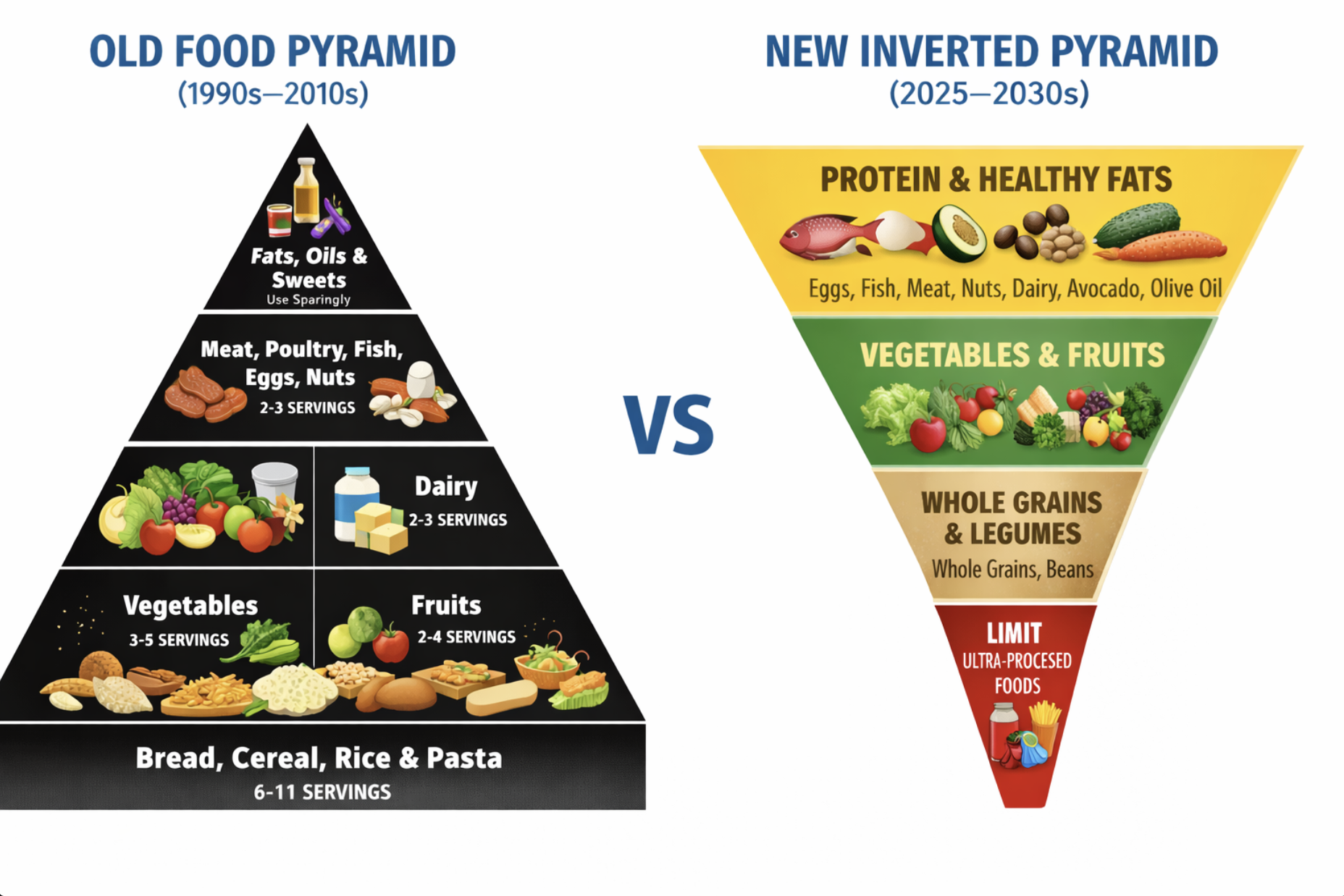
What You Need To Know About the 2026 U.S. Food Pyramid
Big news last week.
The government released updated nutrition guidelines.
And naturally, every fast food chain in America immediately filed for bankruptcy as people ditched drive-thru habits, stocked their fridges with whole foods, and started making perfectly balanced meals at home.
Oh wait. That didn’t happen at all.
Because having more information about nutrition has never been the problem.
To their credit, the new guidelines are actually pretty solid. Here is the plain English version.
1. The big theme is real food.
Less ultra processed stuff. Fast food, cookies, crackers, pastries, packaged snacks. You know, the addictive stuff.
More food that looks like it came from a plant or an animal instead of a factory.
2. Protein finally gets some respect.
They are pushing protein at every meal instead of the old approach of building meals around bread and hoping it works out.
They recommend roughly:
A 150 lb person eat about 80 to 110 grams per day
A 180 lb person eat about 100 to 130 grams per day
That is a big step in the right direction, especially if you work out or want to improve body composition.
3. Ultra processed foods are directly called out.
Not “limit occasionally.” Not “enjoy in moderation.” They’re clearly saying packaged snacks, sugary drinks, and ready to eat junk should be avoided most of the time.
We don’t advocate totally eliminating foods you enjoy, but if you struggle with overeating these, they need to be stripped down to bare bones amounts.
4. Added sugar gets tighter limits.
Especially from beverages and sneaky sources. This isn’t “new”, but the language is stronger than past versions.
They recommend keeping added sugar under about 50 grams per day.
For context:
3 Oreos have about 13 grams
A can of Coke has 39 grams
A grande sweetened latte has around 40 grams
And watch out for sneaky sources like dressings, sauces, and “healthy” foods like baked beans, which can have 15 to 20 grams of added sugar in a half cup.
5. Fat gets confusing.
They still recommend watching saturated fat intake for heart health. That part makes sense.
At the same time, they recommend full fat dairy and non lean meats, which are higher in saturated fat.
So the practical takeaway becomes something like:
Eat some of these foods, but don’t overdo them.
For most people, it makes sense to get the majority of your fats from unsaturated sources like avocados, fish, olives, nuts, and seeds, rather than piling it on from animal sources.
6. Vegetables, fruits, and whole foods are still the foundation.
No breaking news here. Whole foods, fiber, and minimally processed options should make up the base of your diet. Most people still undereat them by a long shot.
All of this stuff is good information.
But if information actually changed behavior, DoorDash wouldn’t exist, and January gym crowds would last past Valentine’s Day.
Most people don’t struggle because they don’t know what to eat.
They struggle because life gets busy, stressful, and unpredictable. And when it does, they have no system or habits that keep them on track.
If your New Year’s momentum is already wobbling, you’re normal.
If you are thinking, “I know what to do, I just cannot seem to stick with it,” you are not broken.
More information is not the answer.
Support, structure, and help applying these basics to real life is.
That’s the work we do with our clients every day.
If you want help figuring out what this looks like for you, click the yellow button below, and I’ll send you our program pricing and options today.
Jonathan
P.S. - Here’s a visual of the old vs. new food pyramid: