
Should You Weigh Yourself Every Day? Here's Why Daily Weigh-Ins Can Help With Weight Loss
“I love weighing myself Monday morning after a fun weekend.”
Sincerely, No one ever
Even so, Blakley and I weigh ourselves every morning, including Mondays.
And most of our clients who are trying to lose fat do too.
Not because we're obsessed with the number on the scale.
Quite the opposite.
We weigh daily because one weigh-in doesn't tell you very much.
If you're not trying to change your body composition or maintain recent weight loss, there's probably not much reason to weigh yourself every single day.
But if you're trying to lose fat, build muscle, or make some other change to your body, weighing yourself regularly can give you a LOT more useful information.
Why Weigh Yourself Every Day?
Why not just weigh on Friday morning?
That sounds nice.
Especially if you've had a good week and want to see a nice, tidy number before the weekend starts.
Or maybe just weigh once a month when you happen to feel particularly light.
The problem is that your weight fluctuates.
A lot.
I know I can be up 2 pounds one morning for seemingly no reason.
Then down a pound and a half the next day.
It's all over the place, really.
And that brings me to the first reason I like daily weigh-ins.
Reason #1: Daily Weigh-Ins Can Keep One “Bad” Weekend From Looking Like a Bad Week
Let's say I'm doing everything right Monday through Friday.
Training is on point.
Nutrition is on point.
I weigh myself Friday morning and see 160 lbs.
Excellent.
Then Friday night I get cozy with some lasagna and Buffalo Trace.
Saturday and Sunday aren't exactly what you'd call a nutrition masterclass either.
If I weigh myself Saturday, Sunday, and Monday, I might see something like:
161.5 → 162.75 → 163.5
Not exactly the direction I was hoping for.
But then I get back to my normal routine.
By Friday, I'm back down to 161.
Now imagine I ONLY weighed myself on Fridays.
I'd see:
Last Friday: 160
This Friday: 161
And I'd probably think:
“I've been killing it all week, and I STILL GAINED A POUND!!! THIS ISN'T WORKING!!! I GIVE UP!!!”
#sad
But if I had been weighing myself every day, I'd have seen the whole story.
I'd have seen the gradual climb over the weekend, and I'd have seen it come back down as I returned to normal.
I also might have had a little gut-check Saturday morning before going back for that leftover lasagna.
More importantly, I wouldn't have mistaken one data point for the entire story.
Reason #2: Your Weight Is Supposed to Fluctuate
I've had clients see 5, 6, even 8-pound swings in their weight over a very short period of time.
And no, they did not gain 8 pounds of fat overnight.
See, most of your body is water.
Your hydration, sodium intake, carbohydrate intake, sleep, stress, workout intensity, medications, digestion, and approximately 5,000 other things can affect how much water you're carrying from day to day.
So you might wake up heavier tomorrow even though you did everything “right.”
You also might wake up lighter after a day when you didn't.
That's why trying to determine whether you're actually losing fat based on one morning's weigh-in is basically like trying to determine the weather for the entire month by looking out the window at 7:00 AM on Tuesday.
You need more data.
That's where the weekly average comes in.
Why Your Weekly Average Matters More Than Your Daily Weight
Check out this client's weight chart.
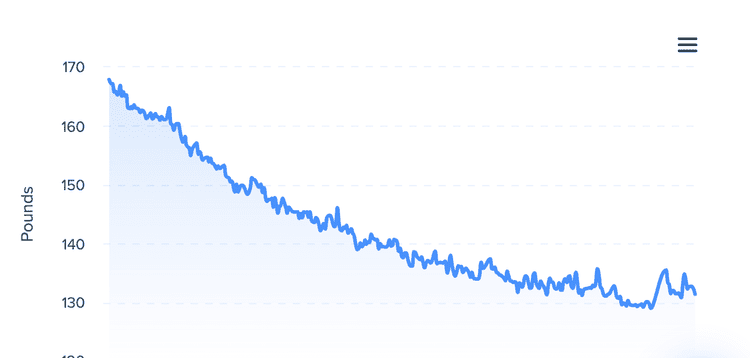
She lost an impressive 35 pounds of fat, but as you can see, her weight didn't politely march downward every morning.
Not even close.
There were ups.
There were downs.
There were moments where she wanted to quit.
But since she weighed herself every day, we could take all 7 weigh-ins and calculate her weekly average.
Then we compared that average to the previous week's average.
Now we had something useful.
Instead of asking:
“Why am I up 1.5 pounds today?”
We could ask:
“What's happening with my average weight over the last few weeks?”
That's a much better question, and it showed the progress she was truly making.
Those daily weigh-ins also helped us learn how her body responded to different foods, changes in activity, sleep, stress, and all the other things that affect scale weight.
A high weigh-in became more of an:
“Ahhh. I see why that happened.”
instead of:
“AHHHHH! I'M GONNA DIE!!!”
That's a much healthier relationship with the scale than giving it the side eye the day after you overdo it.
But What If Weighing Yourself Makes You Emotional?
I get it.
Knowing logically that your worth has absolutely nothing to do with your weight doesn't necessarily make seeing a higher number easy or fun.
So if stepping on the scale every morning sends you into a tailspin, I'm not telling you to force yourself to do it tomorrow.
Start smaller.
Weigh yourself 2 or 3 times per week for a couple of weeks.
Get used to seeing the number go up and down without immediately deciding that something has gone horribly wrong.
Then go to 4 days.
Then 5.
Eventually, you may find that the number doesn't have nearly as much power over you as it used to.
I've watched this happen with countless clients.
People who used to dread the scale eventually got to the point where they could step on it, record the number, and move on with their day.
That's the goal.
Don't fixate on the daily number.
Use the daily numbers to create a bigger picture.
Record all 7 weigh-ins.
Calculate your weekly average.
Then look at the trend over several weeks.
If that average is moving in the direction you want, keep doing what you're doing.
And if it isn't, you have some actual data to help you decide what to change.
The scale isn't your report card.
It's just a measuring tool.
Use it that way.
Have a great day, friends!
Jonathan
P.S. We can help you walk through this entire process with the Nutrition Freedom Framework. You can apply for coaching below.
